
"Czero is one of the best companies I have worked with for analysis and simulation; including dynamic modeling, CFD and FEA. Their deep expertise and comprehensive quality system ensure accurate results. Czero's project management is excellent, providing clean concise information on progress, schedule and budget. Czero is a go-to source for projects ranging from analysis and simulation to prototype product development and testing. They deliver strong solutions to the challenges faced by Offshore and Subsea markets."
Gas and Liquid Interactions
Multi-species, multi-phase gas and liquid dynamics analysis plays a crucial role in Czero's engineering by providing in-depth understanding of how different gases and liquids interact in a system. This type of analysis is especially important in our projects, where optimizing energy efficiency, reducing emissions, and ensuring the safety and reliability of systems are key objectives.
For our projects involving hydrogen fuel cells, carbon capture, or biomass processing, this analysis allows our engineers to simulate the behavior of gases like hydrogen, carbon dioxide, and methane under various operating conditions. Multi-phase modeling helps in understanding phase transitions (e.g., gas to liquid) and the transport of these fluids in devices such as reactors, pipelines, and separators.
This method aids in optimizing system performance, ensuring operational safety, and improving the design's sustainability, ultimately leading to the creation of more effective and efficient clean energy solutions while minimizing environmental impact.
Key points about multi-species, multi-phase gas and liquid dynamics that Czero focuses on include:
- Interaction Between Phases: In systems where gases and liquids coexist, such as hydrogen storage or carbon capture, it is critical to understand how they interact. Multi-phase dynamics allow for the analysis of flows, phase transitions, and mass exchange between phases.
- Species-Specific Behavior: Different species (gases or liquids) in the system can exhibit distinct behaviors based on their chemical properties, such as solubility, reactivity, or phase change potential. This is essential in fields like biomass gasification and fuel cell technology, where multiple gases react and separate.
- Energy Efficiency: Accurately modeling these dynamics helps optimize energy efficiency in processes such as heat transfer, separation, and compression, making them vital for clean energy technologies like hydrogen production or carbon storage.
- Environmental Impact: Multi-phase, multi-species dynamics are crucial for reducing environmental impact by enabling better control of emissions and efficient resource utilization.
These analyses contribute to better design and operational safety in complex energy systems.
Usage
Czero has utilized versions of the multi-species multiphase real gas block set of a wide range of applications, prior example projects include:
- Carbon Capture and Storage (CCS): In CCS systems, multi-species gas dynamics are important for modeling the separation of carbon dioxide from flue gases, as well as the transport and storage of CO₂ in liquid or supercritical phases underground. Understanding the interaction between gases (such as CO₂ and nitrogen) and liquids in pipelines and storage is critical for optimizing efficiency and safety.
- Hydrogen Production and Storage: In hydrogen production (e.g., steam methane reforming) and storage, multi-phase dynamics help analyze the separation of hydrogen from other species like methane and carbon monoxide, as well as phase transitions between gaseous and liquid hydrogen. Accurate modeling ensures efficient storage and transport.
- Biomass Gasification: In gasification processes, biomass is converted into syngas (a mixture of hydrogen, carbon monoxide, and other gases). Multi-phase gas and liquid dynamics help simulate the flow and reactions of multiple species, allowing engineers to optimize reaction efficiency and minimize byproducts.
- PEM fuel cells - Gas dynamics play a crucial role in Proton Exchange Membrane (PEM) fuel cells by managing the complex interactions between gases (hydrogen and oxygen), liquid water, and the membrane's phases. Czero can optimize fuel cell design, improve efficiency, and extend the life of PEM fuel cells, which are essential for clean energy applications such as electric vehicles and stationary power generation.
- Solid oxide fuel cell/gas turbine hybrid system - Multi-species, multi-phase gas and liquid dynamics are critical for optimizing performance and efficiency through fuel and air management, exhaust gas utilization, heat and water management, and fuel reforming.
- Alkaline electrolyzer - Dynamics are essential for optimizing hydrogen production through water electrolysis. These dynamics play a role in several key processes, including electrolysis reaction, gas-liquid separation, and mass transport, which involves understanding how ions, such as hydroxide ions (OH-), move through the electrolyte.
- Gas turbines - Multi-species, multi-phase gas and liquid dynamics are crucial for modeling and optimizing the performance of combustion and cooling processes. These dynamics involve the interaction between various gases (like air, fuel, and exhaust) and liquids (such as water or fuel droplets) in different phases—gas, liquid, and occasionally solid particles (like soot).
- Refrigeration and heat pump systems - The dynamics play a critical role in optimizing the performance and efficiency of these systems, including refrigerant flow and phase changes, heat transfer efficiency, leak detection and refrigerant behavior and environment impact.
- Waste heat recovery systems - Multi-species, multi-phase gas and liquid dynamics are critical for optimizing the conversion of waste heat into usable energy. These systems often involve heat exchange between gases and liquids, requiring precise modeling of how different phases and chemical species interact under various conditions.
- High-temperature thermochemical energy storage - The dynamics play a crucial role in managing and optimizing the chemical reactions that store and release energy. These systems often rely on reversible chemical reactions, where gases and liquids are involved in transferring thermal energy.
These examples illustrate how multi-species, multi-phase dynamics enhance the understanding and engineering of our complex energy systems, leading to better performance and sustainability.
FEATURED PROJECTS
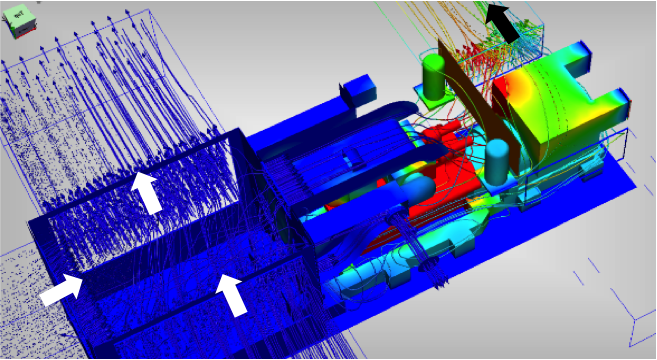
Advanced MATLAB Simulink Multi-Species Multi-Phase Block Set
Czero Engineering Overview
Czero Capabilities
Software & Tools
Custom-built tools
We have many projects that require modeling tools beyond what is available in commercial software, so we develop our own. While we could purchase software to meet individual necessities – to model a chemical process, to create a physical model, or to generate a controller model – we have found that often the software does not play well together. Therefore, we develop our own tools to perform these highly complex integrations. Case in point, Czero has developed a set of custom blocks in MATLAB/Simulink to support projects that require tracking of multiple fluid species, with phase changes and chemical kinetics. Because they were built from the ground up, they are customizable for just about any combination of species and ranges of pressure and temperature. Czero can leverage this library of tools for any project, reducing cost and development time, while customizing them for a client’s specific needs.
MathWorks partner
Czero is proud to be a MathWorks partner, which is a small network of MathWorks-vetted, 3rd party providers who develop products and services utilizing MATLAB and Simulink. Combining the power of MathWorks tools with Czero engineering experience has enabled proven results across multiple demanding projects.

Software & Tools
- ANSYS
- MATLAB/Simulink/Simscape
- STAR CCM+
- Converge
- FEMM
- GT-SUITE
- Solidworks Simulation
- EES
- REFPROP (NIST)
- Bentley AutoPIPE




- Horst Moll, Former First Chief Engineer, Aker Solutions

"Nexceris has been working with Czero since 2018 to develop and demonstrate a 50-kW scale hybrid power system for a government customer (ARPA-E). Czero led system design and controls development, and currently is leading system construction and testing work on the project. Czero engineers are extremely talented, innovative, detail oriented and responsive. I have thoroughly enjoyed our collaboration and provide my highest recommendation."
- Scott Swartz, Founder and CTO, Nexceris

"PDC Machines- a compression and refueling technology provider to the world’s emerging hydrogen economy has been working with Czero for over 6 years on a combination of greenfield new technology and incremental technology improvements to our product. They have been able to take our napkin sketch frameworks and work with our team to deliver minimum viable product to complete solutions which are efficient, marketable and in many cases patentable. Their clear and simple approach to partnership- working as part of one team PDC staff is why I believe in the growing foundation we started 6 years ago."
- Kareem Afzal, Executive Chairman, PDC Machines
"We chose Czero since they have a stellar reputation for innovation and expertise in the automotive industry. They also have a proven track record and prior history with the original inventor [of Onboard Dynamics natural gas refueling technology]—who is on our team—that has already resulted in huge successes in meeting critical milestones and performing to expectations."
- Rita Hansen, CEO Onboard Dynamics

"I have a >$1M US Department of Energy research effort for which I was understaffed and lacking specific subject area expertise. Czero was able to engage last minute to displace a well-known automotive engineering company at a fraction of the price. Over a year into the project, Czero has continued to be responsive and trustworthy; their engineering performance has contributed significantly to an increase in project funding from the sponsor. As the project principal investigator, selecting Czero as an engineering services company has been one of the best decisions I have made."
- Chris Hagen, Assistant Professor, Energy Systems Engineering Oregon State University – Cascades

"Czero’s work with us to fully understand the requirements of the end product for the new reactor engine system has been instrumental in developing a completely new, innovative system. From these requirements, they were able to quickly come up with multiple concepts for vetting against the tough project objectives, which include not only technical feasibility but also aggressive cost targets. The in-depth simulation and analysis of the various concepts that Czero did ahead of time has built tremendous confidence we are going down the right path."
- Devin Halliday, Principal Investigator, Gas Technology Institute

"Czero’s ability to work with our engineers in developing innovative, ground-breaking technology has been a great benefit to the SuperTurbo development. We have placed a lot of trust in Czero’s ability to deliver and have not been disappointed. They are a top-shelf organization."
- Tom Waldron, Executive VP, SuperTurbo Technologies

“My initial request to Czero was to develop software and the associated controller needed for a very important competitive assessment of our product. Due to the nature of the project, I needed the work to be accomplished and in my customers hands within 2 months, which was a very aggressive necessary timeline for this level of work. Not only did Czero get the software and ECU requirements done to spec, but the system was delivered to my customer ahead of time to support the testing. The expertise, timeliness, and quality of the Czero solution was outstanding!”
- Bradlee J. Stroia Ph.D., Stanadyne Operating Company LLC

"We’ve had an absolutely fantastic, positive experience with Czero and I wholeheartedly endorse them. They are more than a typical ‘throw it over the fence’ engineering consulting firm, as Czero not only develops a strong understanding on the background of the project, but they also think along the way and offer suggestions and ideas beyond the scope of the simple engineering contract deliverables. And, they deliver, too. They are really solid, outstanding people."
- Steve Kloos, Former CEO AquaHydrex

"The engineers on the Czero team were proactive problem-solvers from our first introduction. They quickly applied the full breadth and depth of their engineering team’s impressive intellect to determine the most efficient and cost effective system to maximize the energy-harvesting capabilities of Brown’s concept.
They were remarkably objective in their trade studies to find the best solution, favoring a simpler mechanical solution over their greatest strength: advanced hydraulics. They walked us through potential failure modes of each system, and educated the team about the pitfalls of component scalability. In addition to their technical solutions, Czero did an excellent job conveying their thought process and analysis to the Brown team with clear graphs, diagrams and presentations, which streamlined decision-making.
Czero added tremendous value to the Brown project and was a pleasure to work with. We look forward to putting our heads together on future projects."
- Tom Derecktor, CEO

"Czero has been an invaluable and integral part of our program. From component and subsystem design to detailed system performance analysis, Czero’s integrated engineering approach has allowed us to develop elements quickly to meet the very ambitious schedule challenges imposed by our U.S Department of Defense contract."
- Scott Frazier, Co-founder and CEO

"Czero has been a valuable strategic partner in helping FACTOR[e] startups advance technologies quickly while staying lean during their crucial first two years. We know Czero’s agility, creativity and process. We trust their team. We’ve seen their technology insights and the business value of what they deliver."
- Morgan DeFoort, CEO

"As we move from R&D to commercialization, Czero is providing top-notch engineering support to our team, transforming our ideas and concepts from prototype designs to viable commercial products. Czero really digs into the requirements before starting the design process, enabling us to easily collaborate on design options that optimize our product designs to meet market demand and ensure customer satisfaction. Without hesitation, we recommend Czero to anyone wanting to accelerate R&D and product development."
- Steve Witt, CEO, OptiEnz Sensors

"Czero understood our test objectives very quickly and communicated systematically to define the test procedure, scale model details, and test fixture that fulfilled all test requirements quickly and safely. They creatively utilized off-the-shelf items in the scale model to keep its cost low and provided a clear, concise report—including useful insight—within a week of test completion. Helix is very pleased with the service provided by Czero."
- Roy Cottrell, Engineering Manager, Helix ESG

"With extensive experience in engine systems design, Czero played a vital
role in helping Logimesh expedite concept-to-prototype development and
testing of our award-winning Logimote engine health monitoring platform."
- Bill Gillette, President & CEO, Logimesh Technologies, LLC

"Czero was the right partner to help us design our custom grist bin and bag intake station. They found the perfect balance between a properly engineered solution, a cost effective solution, and an aesthetic solution."
- Bryan Hermann, Technical Director, K-MALT
"The true sign of individual or organizational dynamism is the willingness to take risks. It signals real confidence in capabilities and know-how, the flexibility and creativity to explore and test new solutions, and guts to do what it takes to deliver under real economic and technical uncertainty. Czero epitomizes those characteristics and combines them with old-fashioned integrity and reliability. Needless to say, their engineering and technical capabilities are superb. As a young company commercializing real black-box technology, we've entrusted Czero with taking responsibility for critical design and engineering tasks for which there are no precedents, i.e. it has never been done before. They have delivered, under demanding time and resource constraints, and set a very high bar. Culturally and otherwise, they are an ideal partner for young startups who need deep-dive, blank-slate engineering solutions. I would recommend them to anyone."
- Richard Kinsman, former President & CEO, CO2 Nexus Inc. (now Tersus Solutions)

"Czero was an insightful and very technically proficient group that were instrumental in helping us develop our technology. They were very quick studies to understand the fundamental challenges we faced and design/build solutions around them. Top qualities: Great Results, Personable, Good Value.
- Doug Henston, Former CEO, Solix Biofuels
"Czero understands technology development from the back-of-the-napkin stage to the product launch stage. I've never met a team who is more capable of keeping the end-product vision in mind during the early stages of engineering."
- Sam Jaffe, CEO, Panea Energy
"Czero provided a custom engineering solution to our need to convey conceptual functionality. Their approach was creative, effective, high quality and fast. Highly endorsed."
- Rick Dunagan, Partner, Symbiotic Solutions
"To work with Czero is nothing short of a privilege. Stemming from their excellent credentials and strong analytical aptitude, they consistently translate complex technical situations into plain English to allow multidisciplinary group to function together seamlessly."
- Nick Rancis, Co-Founder and Principal, Tierra Verde Consulting LLC
"I was extremely impressed with how quickly Czero understood the needs and intent of the bearing housing design and how responsive they were in completing the drawing package."
- Scott Taylor, VP of Engineering, TMA Global Wind Energy Systems
Reach out to us, schedule a meeting, and let's find your custom solution.
We offer concept-to-prototype mechanical engineering R&D for developing systems and subsystems for cleantech innovations. Learn how we can help your team.